



Texas Instruments LMH2832 Digital Variable Gain Amplifier (DVGA)
Texas Instruments LMH2832 Digital Variable Gain Amplifier (DVGA) is a high-linearity, dual-channel, digital variable gain amplifier for high-speed signal chain and data-acquisition systems. The LMH2832 is optimized to provide high bandwidth, low distortion, and low noise. This optimization makes this device ideally suited as a dual, 14-bit, analog-to-digital converter (ADC) driver. The device consists of one fixed-gain block and one variable attenuator consisting of a total gain of 30dB with a maximum attenuation of 39dB. The gain range is from 30dB to –9dB in 1dB gain steps with a gain accuracy of ±0.2dB. The Texas Instruments LMH2832 is designed to drive general-purpose ADCs and meets both data over cable service interface specifications (QAM and OFDM systems). With excellent NF (6.5 dB) and linearity, the LMH2832 is designed to perform within DOCSIS specifications.
Features
- Dual-channel, individual SPI™-controlled DVGA
- Single 5V supply
- –3dB bandwidth (1.1GHz (max gain))
- 300MHz flat bandwidth response
- ±0.05dB channel-to-channel gain matching
- ±0.1° channel-to-channel phase matching
- Gain
- 30dB to –9dB
- 1dB steps ±0.2dB
- Output third-order intercept point (OIP3)
- 43dBm at 300MHz
- 51dBm at 200MHz
- Noise Figure (NF)
- 6.5dB (max gain) at 300MHz, ZIN = 150Ω
- Adjustable power consumption
- 90mA to 108mA per channel
- Power-saving, power-down feature
- IQ < 4.5mA per channel
- Power-down pin and SPI programmability
- Input return loss at 300MHz
- 17dB (RS = 150Ω)
Applications
- DOCSIS 3.1 CMTS upstream direct sampling receivers
- CATV modem signal scaling
- Programmable gain IF amplifiers
- Generic RF, IF gain stages
- ADC drivers
Functional Block Diagram

Related Development Tool
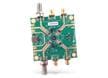
Texas Instruments LMH2832EVM Evaluation Modules (EVMs)
Used to evaluate the dual LMH2832, a digitally-controlled variable gain amplifier (DVGA).
Publicado: 2016-09-02
| Actualizado: 2022-10-20